

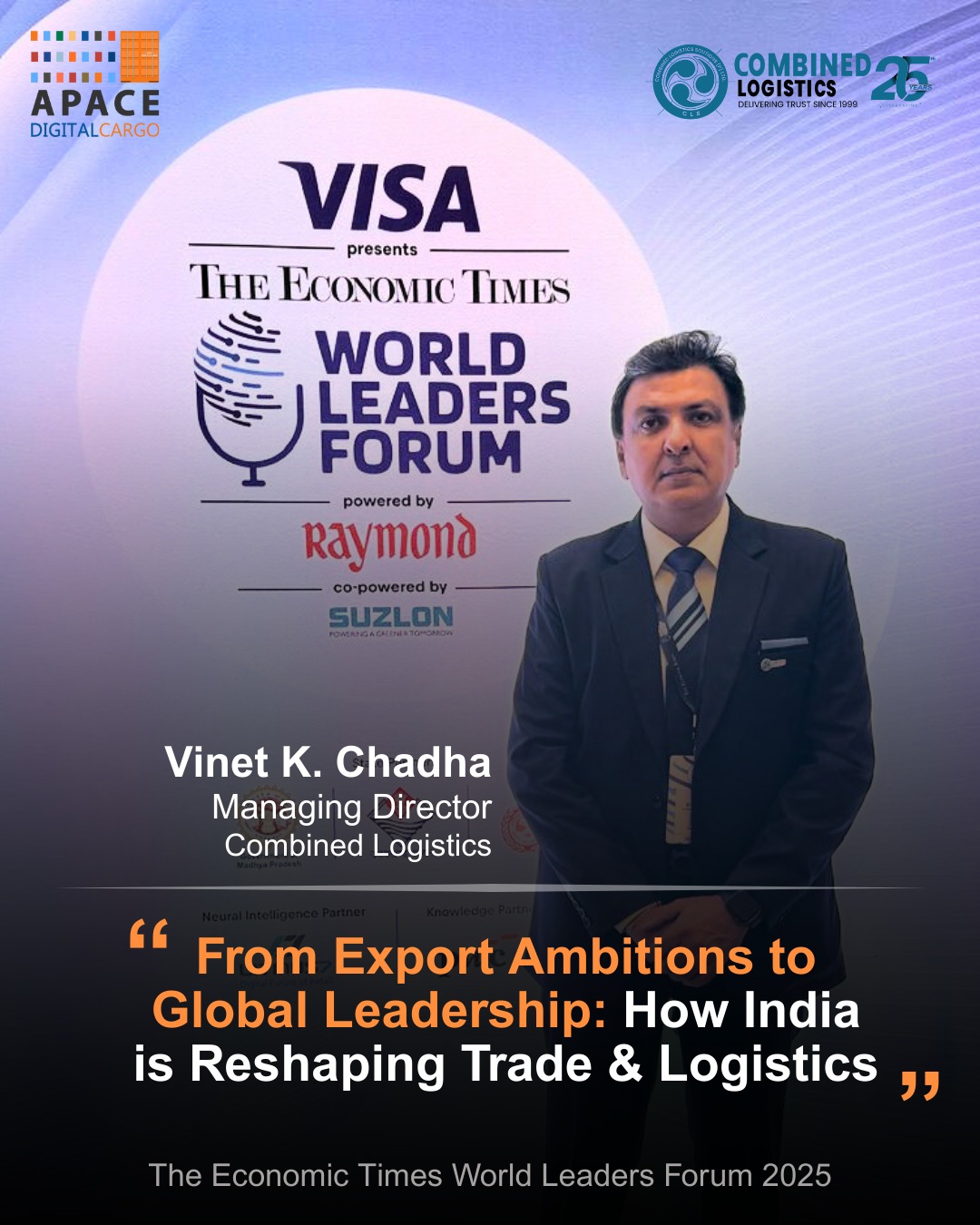
India is at a pivotal moment in its economic journey, transitioning from an emerging market to a global trade powerhouse. At the recent Economic Times World Leaders Forum 2025 in New Delhi, policymakers, industry stalwarts, and international voices came together to outline how India is driving self-reliance, boosting exports, and building world-class infrastructure to support its global ambitions. In this guest column, Vinet K. Chadha, Managing Director, Combined Logistics, had the privilege to witness these discussions firsthand and reflect on what they mean for India’s future in global commerce.
India’s ascent on the global trade stage was on full display at the recent Economic Times World Leaders Forum, held on 22nd and 23rd August at Taj Palace – New Delhi attended by luminaries including Prime Minister Narendra Modi, Union Ministers, leading state chiefs, and international business icons. The forum highlighted India’s ambitious vision: becoming a self-reliant, export-driven, and globally competitive economy. Managing Director , Combined Logistics Solutions, Vinet K. Chadha participated to witness firsthand how India is shaping its trade and logistics landscape.
Export Ambitions and Self-Reliance
Prime Minister Narendra Modi emphasized that India is boosting exports across sectors, from agriculture (farm exports crossing ₹4 lakh crore) to electric vehicles reaching over 100 countries. Reforms in port and shipping laws, along with tax simplifications, are improving logistics efficiency, making India a more attractive trade partner. Defense Minister Rajnath Singh showcased the Make in India success, with defense exports growing 35× in a decade (~₹23,622 crore) and serving nearly 100 countries. This highlights India’s growing manufacturing prowess and logistics capability.
State leaders reinforced this vision: Madhya Pradesh, under Chief Minister Mohan Yadav, recorded ₹66,000 crore in exports while funding growth without new loans, demonstrating fiscal stability and pro-investment reforms. Andhra Pradesh’s N. Chandrababu Naidu stressed the need for India to produce global brands, leveraging technology and human capital, including the launch of India’s first quantum computing facility in 2026.
Infrastructure and Logistics: The Backbone of Growth
Union Minister Nitin Gadkari outlined India’s massive infrastructure push: green highways, tunnels, ropeways, and alternative fuel investments aimed at cutting logistics costs (~10% of GDP) and enhancing last-mile delivery. These initiatives, alongside public-private partnerships, reinforce India’s goal of becoming a $5 trillion economy by improving connectivity, reducing trade bottlenecks, and facilitating global competitiveness.
Navigating Global Trade Uncertainty
With rising tariffs, protectionism, and geopolitical tensions, Indian trade leaders emphasized resilience and diversification. External Affairs Minister S. Jaishankar underlined India’s strategic autonomy in sectors like energy and agriculture, while Commerce Minister Piyush Goyal highlighted reforms to ease regulations and protect domestic interests, even as India engages with China, the EU, and other partners.
International leaders added perspective on India’s role in the shifting global economy. Sir Martin Sorrell (S4 Capital) highlighted the rise of emerging markets (E7 surpassing G7) and geopolitical risks that could disrupt trade. Christopher Wood (Jefferies) praised India as the best long-term stock market story, buoyed by domestic capital and macro stability. John Kerry (former U.S. Secretary of State) and Matteo Renzi (former Italian PM) underscored India’s strategic position in global trade, renewable energy, and Europe–India partnerships.
Innovation and Opportunity in the Face of Challenges
Trade protectionism and supply chain disruptions, speakers like Mohamed Kande (PwC International) noted, are catalysts for innovation—spurring digital trade, localization, and creative logistics solutions. Satyan Gajwani (Times Internet) stressed balancing self-reliance with global cooperation, leveraging India’s Talent, Infrastructure, Community, and Knowledge (T.I.C.K.), while David Steinbach (Hines) emphasized that transparency, consistency, and rule-of-law are critical for attracting foreign investment in a less globalized world.
Commerce & Industry Minister Piyush Goyal highlighted India’s resilience in navigating global trade shifts, focusing on strategic FDI reforms, regulatory simplification, and strengthened engagement with key partners like China and the EU. His emphasis on protecting domestic interests while boosting export competitiveness reinforces India’s position in a rapidly changing global trade landscape.
The Road Ahead
India is clearly on a trajectory to become a resilient, self-reliant, and globally competitive trade hub. With infrastructure investments, policy reforms, export-focused initiatives, and a focus on sustainable industries like renewable energy, India is not just responding to global challenges—it is actively shaping the future of global trade. As industry leaders like Vinet K. Chadha observed at the forum, the combined force of state-level innovation, national reforms, and international collaboration positions India to navigate disruption and emerge as a major global economic power.