


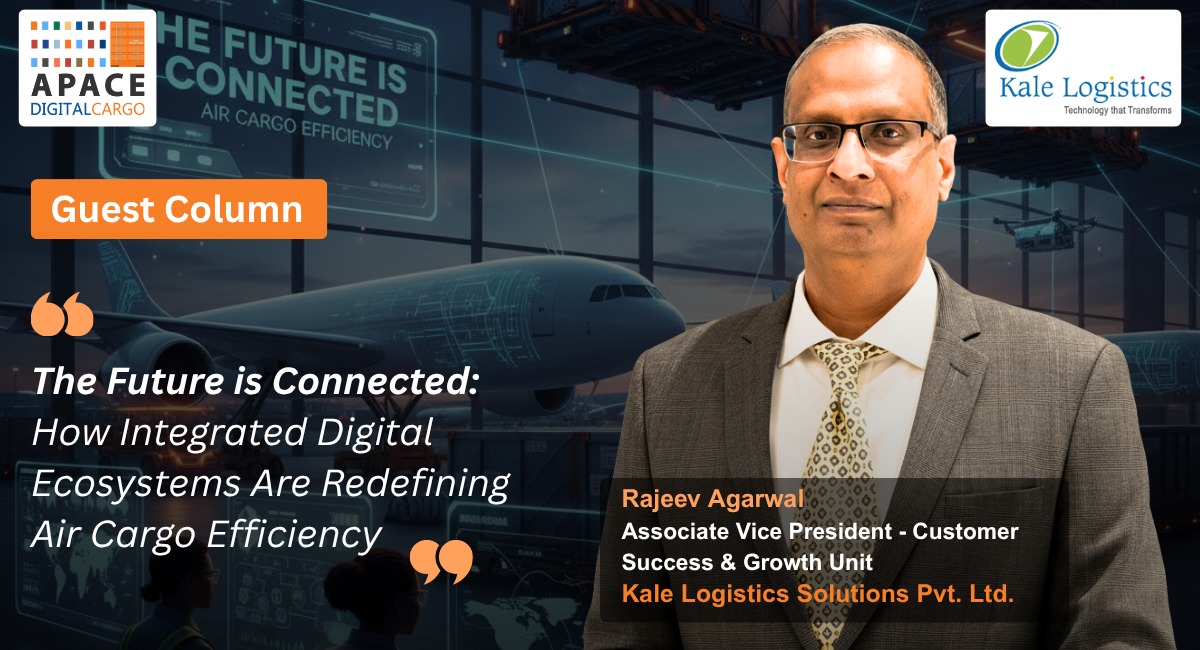
Rajeev Agarwal, Associate Vice President – Customer Success & Growth Unit, Kale Logistics Solutions Pvt. Ltd., shares his insights on how integrated digital ecosystems are redefining the future of air cargo.
The air cargo industry is at a defining moment. As global trade accelerates and customer expectations for speed and transparency grow, the traditional siloed approach to logistics is proving inadequate. What’s emerging instead is a powerful alternative — integrated digital ecosystems that connect airports, airlines, customs, and ground handlers through real-time data exchange and automation.
Today, inefficiencies in cargo processing are largely the result of fragmented systems and manual interventions. According to IATA, nearly 20% of air cargo delays stem from documentation discrepancies or lack of data visibility across stakeholders. Each participant — whether it’s an airline managing flight schedules, customs overseeing clearance, or airports coordinating ground operations i.e., often operates within its own isolated digital environment. This lack of interoperability not only slows cargo flow but also increases operational costs and carbon footprints.
Integrated digital platforms are rewriting this narrative. When data flows seamlessly across the logistics chain, it eliminates redundancy and uncertainty. For example, a unified platform connecting airlines and customs can enable pre-clearance of shipments based on verified digital documents, cutting clearance times by up to 70%. Similarly, synchronizing airport and airline systems enables predictive slot management, reducing congestion on aprons and improving aircraft turnaround efficiency.
Beyond efficiency, the real value lies in real-time visibility. Internet of Things (IoT) sensors, blockchain-secured records, and AI-driven analytics are providing stakeholders with a single source of truth from shipment origin to final delivery. Airlines gain access to accurate cargo status updates, customs can trace documentation authenticity instantly, and airports can proactively allocate resources based on cargo flow projections.
Several regions are already demonstrating this model. In Europe, airport community systems have shown how integrated data sharing between customs, airlines, and forwarders reduces cargo dwell time by up to 50%. In Asia, blockchain-based air cargo networks are enhancing transparency and security, while North American airports are piloting Airport Cargo Community Systems (ACS) to streamline end-to-end operations.
However, achieving this digital harmony requires more than technology — it demands collaboration and trust. Stakeholders must embrace data standardization, shared governance models, and cybersecurity frameworks that protect sensitive trade data while enabling accessibility. The future of air cargo efficiency will depend on how effectively these ecosystems evolve into connected communities, not isolated entities.
As global supply chains face increasing pressure to deliver faster, cleaner, and smarter, integrated digital ecosystems are not just an innovation, they’re an imperative. The future of air cargo belongs to those who can connect the dots, literally and digitally.